
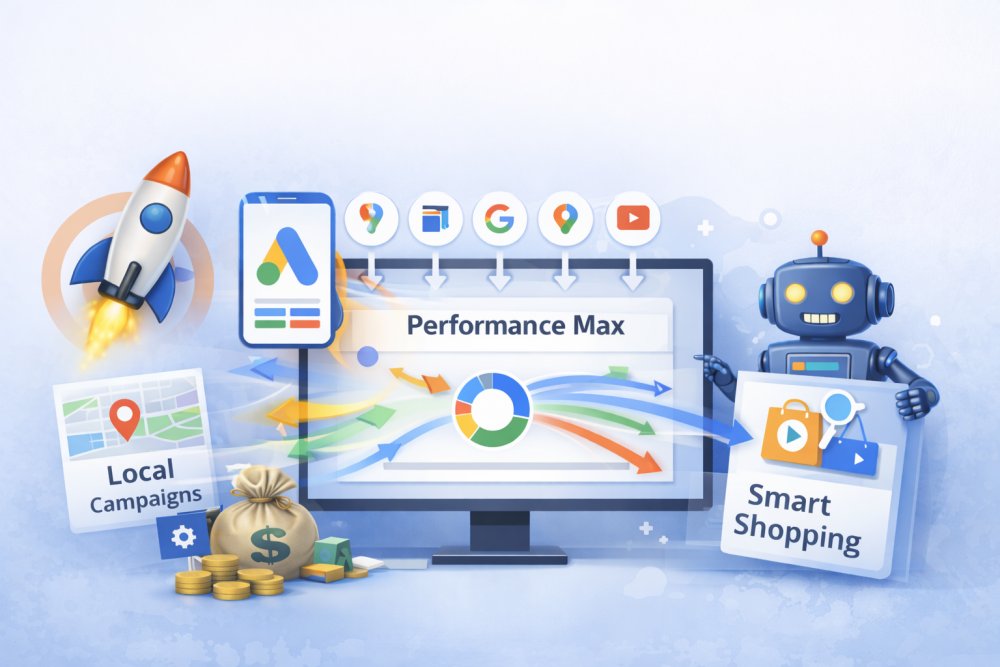
Designed to replace campaign types such as Smart Shopping and Local Campaigns, Performance Max gives advertisers access to all of Google’s advertising inventory through a single campaign. While the promise of automation and broader reach is appealing, many advertisers still question whether Performance Max campaigns truly deliver better results and whether the tradeoff in transparency and control is worth it.
For businesses investing in Google Ads, understanding how Performance Max works, where it excels, and where it falls short is essential for making informed advertising decisions.
What Is a Performance Max Campaign?
Performance Max is a goal-based Google Ads campaign type that allows advertisers to reach users across Google’s entire ecosystem from a single campaign. Instead of creating separate campaigns for Search, YouTube, Display, Gmail, Discover, and Google Maps, advertisers upload creative assets, define conversion goals, set a budget, and allow Google’s machine learning to determine where and when ads are shown.
The concept is simple: Google uses automation and artificial intelligence to identify the users most likely to convert and distributes ads across multiple channels accordingly. While this streamlined approach can save time and increase reach, it also means advertisers surrender much of the manual control traditionally available in Google Ads.
How Performance Max Works
Setting up a Performance Max campaign is relatively straightforward. Advertisers provide headlines, descriptions, images, videos, audience signals, conversion goals, and a budget. Once the campaign launches, Google’s automation handles bidding, audience targeting, placements, and optimization.
Unlike traditional Search campaigns, advertisers do not select keywords, manually manage bidding strategies, or directly control where ads appear. Because of this, conversion tracking becomes one of the most important components of campaign success. Performance Max relies entirely on conversion data to optimize performance. If tracking is inaccurate, incomplete, or improperly configured, the algorithm has limited ability to identify valuable users and improve results.
This heavy dependence on automation is both the campaign’s greatest strength and one of its biggest weaknesses.
The Benefits of Performance Max Campaigns
One of the biggest advantages of Performance Max is the ability to access Google’s entire advertising network through a single campaign. Businesses gain exposure across Search, YouTube, Display, Gmail, Discover, and Maps without needing to create and manage separate campaigns for each channel. For advertisers focused on growth and scalability, this expanded reach can uncover new conversion opportunities that may have been missed through traditional campaign structures.
Performance Max has also demonstrated impressive conversion performance in many real-world accounts. In one medical spa and men’s health clinic account with a monthly ad spend of approximately $12,000, traditional campaigns averaged around $122 per conversion. However, two Performance Max campaigns consistently generated conversions at approximately $30 and $16 each while also delivering the highest volume of leads within the account. Similar results were observed in a Texas-based emergency healthcare account, where traditional Search campaigns generated leads at roughly $78 to $86 per lead, while Performance Max campaigns produced leads between $13 and $18 each.
These types of performance improvements are difficult to ignore, particularly for businesses focused on lowering acquisition costs and increasing lead volume.
The Transparency Problem
Despite its strong performance in many accounts, Performance Max continues to face criticism for its lack of transparency. Many advertisers refer to the platform as a “black box” because so much of the optimization process occurs behind the scenes.
Unlike traditional Search campaigns, advertisers cannot easily see the exact search terms triggering their ads, gain full visibility into audience targeting decisions, or understand precisely how budget is allocated across different channels. While Google has gradually introduced placement reporting, the available data remains limited compared to the level of insight many experienced advertisers expect.
This lack of visibility makes it difficult to determine why certain results occur and limits an advertiser’s ability to make strategic adjustments based on detailed performance data.
Why Performance Max Often Produces Strong Results
Performance Max tends to perform best in established accounts with significant historical conversion data and properly configured tracking systems. Google’s machine learning thrives on data volume. The more conversion history an account has, the more effectively the algorithm can identify patterns and locate similar users across Google’s network.
Businesses with larger budgets, multiple service offerings, and mature advertising programs often see the strongest Performance Max results because the system has more information available for optimization. In contrast, newer accounts with limited conversion data or incomplete tracking may experience inconsistent results while the algorithm learns.
A Smart Budget Strategy for Performance Max
Many experienced Google Ads managers do not view Performance Max as a replacement for traditional Search campaigns. Instead, they use it as a complementary campaign type designed to expand reach and uncover additional conversion opportunities.
A common strategy is allocating approximately 10% to 20% of the overall Google Ads budget to Performance Max while maintaining traditional Search campaigns for high-intent keyword targeting. This hybrid approach allows businesses to retain control over critical search traffic while leveraging Google’s automation to identify new audiences and incremental conversions.
For many advertisers, this balance provides the best combination of control, scalability, and performance.
Performance Max for E-Commerce Businesses
E-commerce advertisers can connect product feeds directly to Performance Max campaigns, allowing products to appear across Google Shopping placements and other inventory sources. While this creates broader product visibility, it also introduces new challenges.
Many advertisers report losing valuable keyword-level insights and search term visibility once product feeds are integrated into Performance Max. Businesses that rely heavily on granular Shopping campaign optimization often prefer maintaining dedicated Shopping campaigns to preserve greater control over performance and reporting.
As a result, e-commerce advertisers should carefully evaluate how much automation aligns with their overall advertising strategy before fully transitioning to Performance Max.
Areas Where Performance Max Still Needs Improvement
Although Google continues to enhance the platform, several limitations remain. Advertisers still have limited access to negative keyword management, detailed search term reporting, audience insights, and channel-specific performance breakdowns. Many marketers would like greater visibility into how budget is distributed between Search, Display, YouTube, Gmail, and Discover placements.
Without these insights, advertisers must place significant trust in Google’s algorithm while sacrificing some of the strategic control that has traditionally been central to successful PPC management.
The Future of Performance Max
As Google continues investing heavily in automation and artificial intelligence, Performance Max will likely remain a major component of the Google Ads ecosystem. Future updates may include expanded reporting capabilities, improved negative keyword controls, more detailed audience insights, and additional transparency regarding placements and channel performance.
Google has a long history of evolving campaign types, so it would not be surprising to see Performance Max continue to evolve in response to advertiser feedback and growing demand for greater control.
Should Your Business Use Performance Max?
Performance Max can be highly effective for businesses with strong conversion tracking, established account history, and a willingness to embrace automation. Companies seeking broader exposure across Google’s advertising network often find value in the campaign’s ability to identify new audiences and lower acquisition costs.
However, advertisers who rely heavily on keyword optimization, search term analysis, and granular campaign control should approach Performance Max strategically rather than replacing traditional Search campaigns entirely. Businesses with limited budgets or incomplete tracking infrastructure should also proceed cautiously until their data foundation is strong enough to support machine-learning optimization.
Final Thoughts
Performance Max campaigns represent Google’s vision for the future of digital advertising: increased automation, broader reach, and machine-learning-driven optimization. In many real-world accounts, including healthcare clinics, medical spas, and emergency service providers, Performance Max has delivered significantly lower cost-per-lead results compared to traditional Search campaigns.
At the same time, these gains often come at the expense of transparency and control. The most successful advertisers are not choosing between Search campaigns and Performance Max—they are using both strategically. By combining the precision of Search with the scalability of Performance Max, businesses can maximize conversion opportunities while maintaining oversight of their overall Google Ads strategy.
Performance Max is not a magic solution, nor is it a campaign type that should be ignored. Like any advertising tool, its success depends on proper implementation, accurate tracking, ongoing optimization, and a clear understanding of its strengths and limitations. For businesses looking to grow through Google Ads, the key is to embrace automation while continuing to make informed, data-driven decisions.